







Just over a year ago, on May 28, 2025, I was preparing for my hardest parenting moment to date. I had to wake up my four year old son, Isaac, and tell him that our cat had died overnight. As a pet owner, I knew this day would come eventually, but I didn’t expect it to happen like this. Reese was only six years old and as far as we knew, she was healthy. I thought we would have another decade with her. She would grow old, or get sick, and we would see the writing on the wall and prepare for her death before it came. Unfortunately, that’s not what happened. When we went to bed, Reese was fine. She was her playful, cuddly self. Then, in the middle of the night, I was awoken by her cries of distress. I rushed her to the emergency vet, and learned she had experienced sudden heart failure. She wasn’t coming home. My heart was broken, and I knew I was about to break my son’s heart.
As the anniversary approached, I reflected on that day, and wanted to share how it went for us, and what we found helpful over the past year. Below are some suggestions on navigating the loss of a pet with a child.
 Treating Death as a Part of Life
The first thing that was helpful for us started long before Reese died. We have never shied away from death in our family and have talked openly about it. Although Reese’s death was my son’s first time losing a loved one, it wasn’t the first time we spoke about death. His first experience was with fish. We’ve had a fish tank his whole life. If a fish died, I would bring him over to the tank. I would say “Look at that fish. Do you see how it isn’t swimming anymore? It’s just laying on the bottom of the tank. Its body stopped working, and it died. We are going to take it out of the tank and say goodbye to it, then we won’t see it anymore.” This happened on a few occasions. He would say goodbye, help me flush it down the toilet, and move on with his day. Then one day, one of my friends died. I was sad, and he asked why. I told him “mama’s friend died, and I’m sad because I won’t see her anymore. I will miss her.” He said “Her body stopped working?” His experience with the fish helped him understand what happened to my friend (although I did have to assure him that we would not be flushing my friend down the toilet!)
Here are some other ways to normalize death:
- When looking at family photos, say things like “that was my grandfather. He was really special to me. He died before you were born, but he would have loved you so much!”
- If someone you know dies and you are sad, don’t hide your emotions. Tell your child what happened.
- Be honest about what happened to that animal you just drove by on the side of the road. “Yes, that skunk died. It probably got hit by a car.”
- Check out the book “Lifetimes” by Bryan Mellonie. It does a beautiful job demonstrating that everything – from plants to people and everything in between – lives and dies. I was introduced to this book after Reese died and found it helpful, but I think it would have been even better to read before we experienced a loss.
Informing Your Child
When its time to inform your child that their pet died, its important to be direct. Say they died. Don’t say “they’re sleeping and won’t wake up” or “they aren’t with us anymore,” as that can be confusing. Reassure your child that they are safe, validate their emotions, and don’t hide your own emotions. Answer their questions the best you can. When I told Isaac about Reese, we were laying in his bed after I woke him up for school I said “Isaac, I have some sad news. Last night, I woke up and there was something wrong with Reese. I brought her to the doctor and they tried to help her, but they couldn’t. Her heart stopped working, and she died.” He took a second to process, and said “Reese died?” I confirmed that she did, and that it was really sad. He asked several questions (Why did she die? How did you know something was wrong? What did she look like when she died? Is Hooper [our other cat] going to die?)
I answered as truthfully as I could. He also asked what happens to us when we die. This answer will vary based on your families beliefs, but I like to say that our loved one lives in our heart, and every time we remember them and talk about them, it keeps their memory alive.
Maintain a Sense of Normalcy
For our family, it made sense to keep our routine as much as possible. Isaac went to school that morning, about an hour after I gave him the news. I did email his teacher ahead of time and let her know what was going on, and told her I would be around and could come pick him up if needed. She let me know after school that she thinks sending him was the right choice for him. She could tell he was sad, but he was happy to be around his friends. Sending him to school also allowed me some time to process. In the week that followed, we went to our scheduled activities and continued our normal routines as a family, but also talked openly about Reese and feeling sad.
Give Them a Chance to Say Goodbye and Memorialize Them
Its important for children to have a chance to say goodbye to their beloved pet. For our family, this meant that I brought Isaac to the vet the afternoon Reese died, and let him see her and say goodbye. (Most vets are happy to allow this to happen, and the one we went to even had a dedicated room for this to happen in.) On the way there, we talked about what she would look like. I told him she would look like she is sleeping, but she is not sleeping, she died. I listed the things that would be different: she would feel cold, she wouldn’t be breathing, and she wouldn’t respond when we say her name or touch her.
When we got there, we were brought to the “good bye room”, and the staff brought Reese in in a small box. I opened it, and he looked at her and gently touched her. He told her he loves her forever, he tucked one of her favorite toys in with her, and he said goodbye. It was honestly a beautiful moment.
For my friends family, allowing their child to say goodbye meant allowing her to be present when their dog was euthanized at home.
If neither of these options feel right for your family, consider having a small memorial service at home with a picture of your pet, and let each family member share what they loved. Perhaps your child could write a letter to your pet (but please do not send it off on a helium balloon – this is dangerous to wildlife).
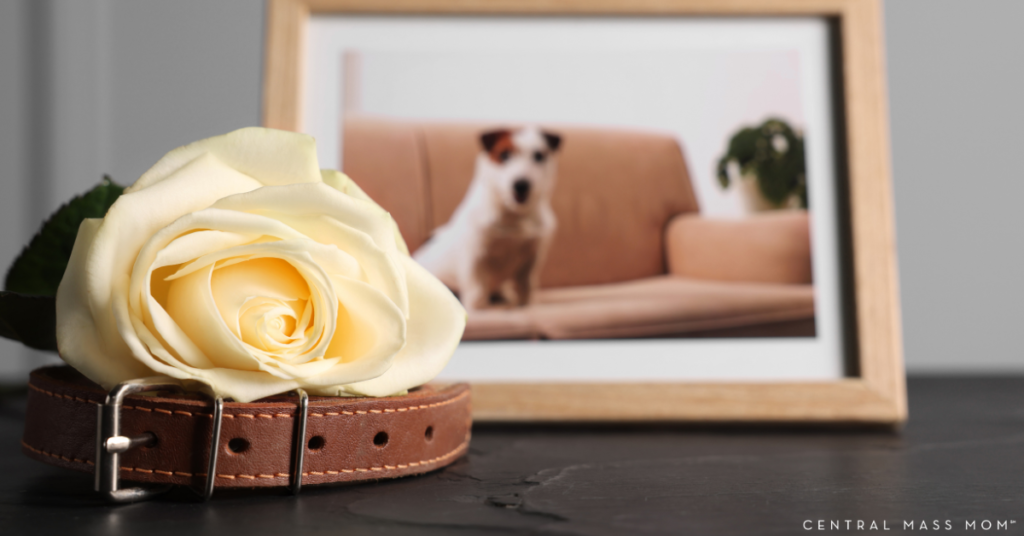
We have a space in our home where we have a photo of Reese displayed with one of her favorite toys, next to her urn. We also bought a stuffed animal for Isaac that looks like her, which he sleeps with and hugs when he is missing her.
Read Books About Pet Loss
Isaac and I have always read a book together every night, and for a couple weeks after Reese died, we were reading books about pet loss. It helped Isaac process and understand that pets die, and other people have gone through this too. It helped him put words to his feelings. I will share a list of our favorites, but I also recommend using your local library. The Children’s Librarian at Marlborough Public Library is truly an angel. Isaac and I visit that library often, and went there after school the day Reese died. I told her we were looking for books about losing a pet. She took the time to listen to Isaac as he told her about Reese, then pulled a few books they had on hand and reserved more for me through inter-library loans. She truly made a hard day better by being so kind and helpful.
These are just a some things that helped me and Isaac in the time immediately following Reese’s death, but its important to remember that grief is an ongoing process. In the year since Reese died, we have continued to talk about her frequently. Sometimes, Isaac still asks to read a pet loss book. He sees a picture of Reese and says “Reese died and I miss her.” One day, he asked to see her ashes. I’ll be honest – I hesitated with this. I had never opened an urn and pictured ashes spilling everywhere, but I called the pet crematory and asked what to expect if I opened the urn. They let me know that the ashes would be in a sealed plastic bag, which would be inside a satin bag. Knowing that, I was happy to let Isaac see. We opened the urn together and looked at the ashes.
We have since adopted a new kitten, Tessie, which brought up complicated mixed feelings of grief and excitement. As excited as we were to welcome Tessie, we also recognized that we never planned to adopt a kitten this year – we planned to have a lot more time with Reese. We talk about how we can love Tessie and miss Reese at the same time, and that’s normal.
Overall, the past year has been filled with a lot of emotions. It’s the first time I have had to walk the journey of grief as a parent, and I am doing the best I can. I hope my experience can help other moms when the time comes for them to walk this journey too.
Book Recommendations
Fluffy and the Stars by T’áncháy Redvers
The Invisible Leash by Patrice Karst
Rodney Was a Tortoise by Nan Forler
The Bug Cemetery by Frances Hill
Cat Heaven / Dog Heaven by Cynthia Rylant
When a Pet Dies by Fred Rogers
Sammy in the Sky by Barbara Walsh
Written by Charlotte Pomerleau

Charlotte lives in Clinton with her husband, Gary; son, Isaac; and cats, Hooper and Tessie. Her family also has about 20 fish, including a betta named Car and panda garra named Oscar the Grouch (guess who named them!). She works as an office adminstrator and is in school part time working on an Interactive Media degree. In her spare time, she enjoys spending time with her family, reading, and going for hikes.