







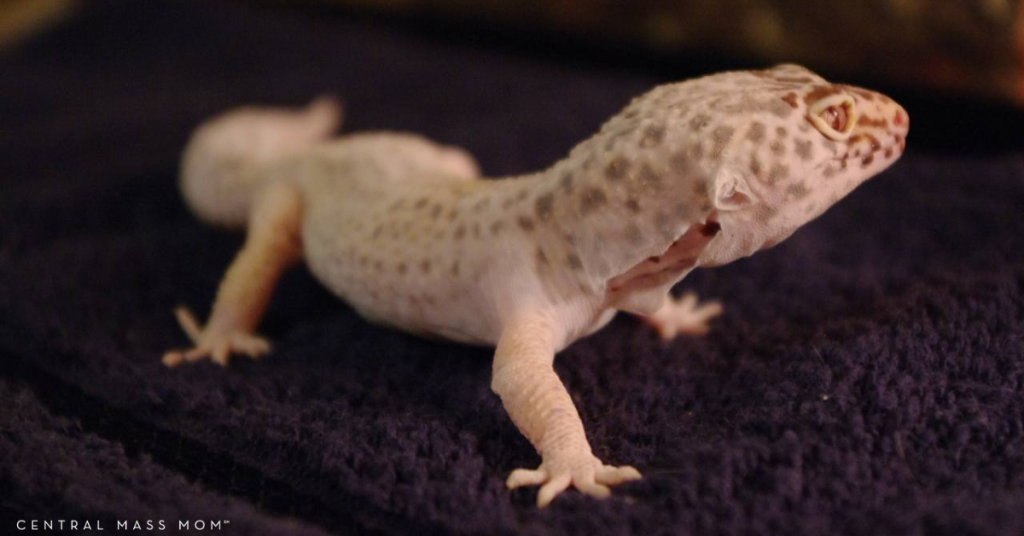
 If your child is asking you for a pet, but you’re not ready for the commitment of a dog or cat, a leopard gecko may be the perfect fit. I learned this alongside my students when I taught Pre-K. Our class fish died on the second day of school, and I realized it was time for something different. My students and I researched different options. I thought maybe we’d end up with a hamster or guinea pig, but when a veterinary student visited with a leopard gecko, it quickly rose to the top of the list of possibilities. I would not call myself an animal person and didn’t have pets growing up, except hermit crabs for a few years, but here’s what I learned owning a leopard gecko.
Below are 7 reasons why leopard geckos are the best first pet:
- A leopard gecko is better than a fish because fish can die quickly, and to keep them alive for long, the tank needs to be cleaned and maintained, which is a pain.
- A leopard gecko is better than a guinea pig, hamster, or rabbit because the cages for these mammals, which can get gross and smelly, need to be cleaned frequently. They would also need to go home with someone every weekend.
- It can be held and taken out of its tank like some of the furry options. But unlike the furry pets, we didn’t have to worry about allergies with a leopard gecko. It can also be left alone for a weekend, which is a huge plus as both a classroom pet or a starter pet at home.
- The cleaning and maintenance for a leopard gecko is very minimal and not labor intensive. It can be as simple as replacing a paper towel about once a week, misting the tank occasionally, and feeding it every few days. So if your child loses interest, you’re not stuck walking a dog or cleaning out urine-soaked guinea pig bedding yourself.
- They eat mealworms and crickets, which can be bought at pet stores. The gecko food is as fun for kids as any other pet. It’s interesting to watch crickets up close, and watching a gecko hunt down a live cricket in the tank can be as entertaining as watching a cheetah hunt its prey on a PBS animal documentary. The mealworms are a whole lesson on life cycles themselves because if a mealworm doesn’t get eaten, it turns into a pupa, and then a beetle pretty quickly.
- Leopard geckos shed their skin (and eat it!) about once a month. It’s fascinating to watch the skin start to look lighter and lighter. Until it’s gone one morning, and the darker skin is back.
- They can drop their tail to escape a predator. That means if a child drops a block on a leopard gecko’s tail, it doesn’t die. (Ask me how I know.) The tail just falls off and slowly regrows. Okay, this may be a bit of a con, too, because it wasn’t exactly pleasant to watch, but it’s better than a squished pet.
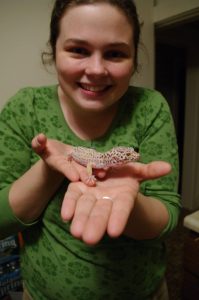 Lizzy (R.I.P.) was a wonderful classroom pet for about eight years. When I took her home over the summers and school vacations, she was super easy. The preschool where I work now has another leopard gecko. I’ve had the opportunity to see my two young sons’ interest in Maui when we take care of him during the summers. If you’re considering a pet, look into a leopard gecko. I don’t think you’ll regret it.