







 My mindfulness journey began more than two decades ago, when I first discovered yoga in ninth grade. I will never forget my very first class. Despite the inevitable giggles while sitting next to my best friend, I felt an unexpected sense of calm wash over me. As I focused on my breath, stretched my body, and centered myself, something inside clicked. Fast forward to my thirties, after a major surgery temporarily sidelined me from yoga and most other activities, I turned to meditation to deepen my practice and find peace in a new way. That’s when I decided to become a mindfulness and meditation teacher. Now, as a therapist-in-training, I weave mindfulness into nearly everything I do, continually discovering new ways it enhances both my personal and professional life.
Start With Your Own Practice
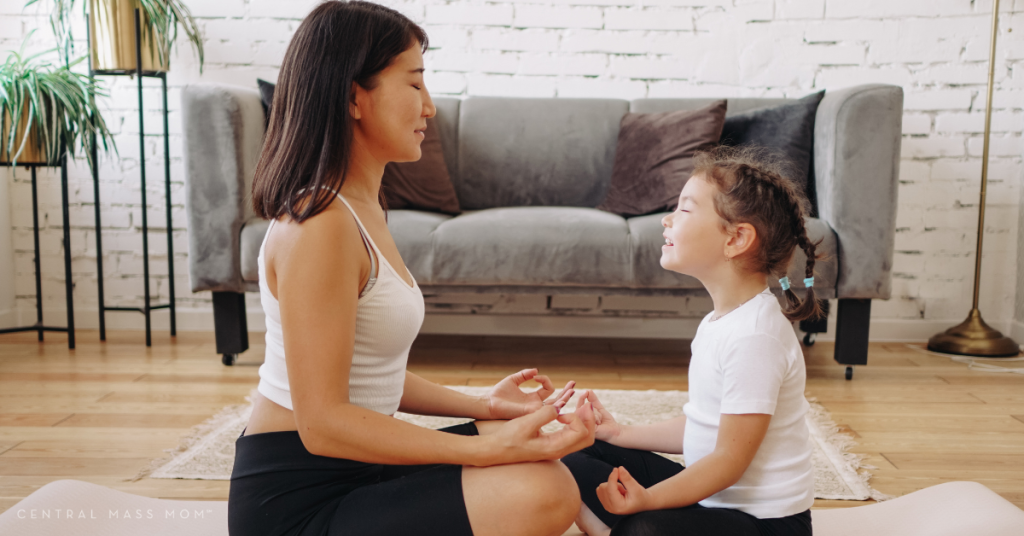
Before introducing mindfulness to your kids, it’s helpful to establish your own mindfulness practice. We know that kids tend to model the behaviors they see in their parents. When they watch you taking time to breathe deeply, focus on the present moment, or manage stress in a mindful way, they’ll likely begin to do the same. The most important lesson to remember is this—there is no right way to practice mindfulness. At its core, mindfulness is about being in the present moment. You can do this through simply paying attention to your breath, using a guided meditation, practicing yoga, or simply being in the present moment.
Make It Fun
I love to teach my kids mindfulness techniques when they are calm and happy, and making it feel a bit silly can make it feel memorable. Some of my favorite ways to do so are:
- Mindful Breathing with Animals: Turn deep breathing into a game by pretending to be different animals. For example, you could “breathe like a lion” (taking a deep, slow breath) or “breathe like a bunny” (short, quick breaths). Let your kids use their imaginations and have fun while practicing.
- 5 Senses: With my five year old, I will do what I call “5-4-3-2-1” (which is also a super helpful tool I use often with my therapy clients). Ask your child to point out five things they can see, four things they can touch, three things they can hear, two things they can smell, and one thing they can taste. This will help them learn to both pay attention and ground in the present moment when feeling overwhelmed.
- Progressive Muscle Relaxation: This is another one that can be great for both adults and kids. Starting with the feet, I’ll have my kids squeeeeeeze their feet as tight as they can, and then release. I’ll repeat that again, and then move to the legs. Slowly, moving up their entire body, they will squeeze and release each muscle group. It tends to get really silly when we get to our faces, and it’s fun to watch them peek to see how scrunched up we can each get.
Practice Breathing
Learning how to breath deeply can be an incredible tool for your children to have in their toolbox. The breath can help us quickly and effectively regular our nervous system, so learning how to do this at a young age is a gift. Here are a few techniques to try out:
- Flower/Candle: To help your child learn how to breathe in through their nose and out through their mouth (an ideal form of breath that leads to greater relaxation), have them imagine holding a flower in one hand and a candle in the other. Have them breathe in through their nose, imagining that they are smelling the flower. Then, have them slowly blow out the candle through their mouth.
- Counting: You can help your child learn to take longer inhales and exhales, which can be relaxing. Start by counting to four as they inhale, and four as they exhale.
- Breath Together: When one of my kids is overstimulated, I will get down to their level, and hold them (foreheads together) and breath together (typically for 5-10 breaths), slowly and deeply. By being with them, your body and breath can begin to regulate theirs.
As with any new skill, mindfulness takes time and practice. Be patient with your child as they explore these tools. Not every child will take to mindfulness right away (or at all), and that’s okay. It is also important to be gentle with yourself as a mom. You don’t need to introduce mindfulness perfectly or have every moment be a “mindful moment.” Simply making mindfulness a part of your family’s life is a huge gift to yourself and your children.