






Our family came into Dungeons & Dragons from four different directions. The first was our twelve-year-old daughter seeking out creative outlets through library events, then local bestselling author R.A. Salvatore, watching The Twenty-Sided Tavern at the Boch Center in Boston, and the last, and most unlikely, was through my group chat of close friends. Admittedly, I was jealous of my friends’ brothers playing when I was in middle school, way back in the 1900s. The storytelling, the world building, constant laughter, and epic stories of trolls and orcs. Plus, there were pretty dice! It was a world I wanted to join, but didn’t know where to start.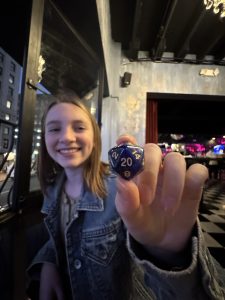
When my husband interviewed R.A. Salvatore, noted alumnus of Fitchburg State University and New York Times Bestselling author of fantasy books set in the D&D universe, a couple of years back, we had no idea this would spark an interest for our family. During the panel, the audience lit up with fandom, asking curious questions about the creative process and gaming. More than anything, it was clear that Dungeons & Dragons is a welcoming, curious, creative group—more akin to an improv troop with lore, magic, and dice.
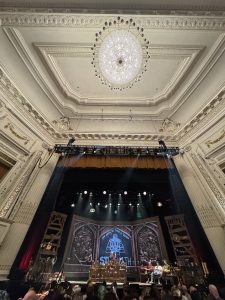
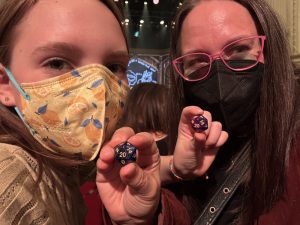 When I had an opportunity to bring my 12-year-old to “The Twenty-Sided Tavern” show at the Boch Center in Boston, we were surrounded by costumed fans of the game in the largest show in TTST history! (I highly recommend seeing TTST if it’s coming to your area!) New players mingled with professional Dungeon Masters, along with people who had never played but liked a good show based on improvisation and audience participation. We took in the magic of the theatre surrounding us, the interactive show using our phones to decide the future of the characters on stage, and chatted with our section neighbors. A father and son sat behind us, one of whom had been playing since the 1980s and the other who had been playing since the early aughts. We represented three generations of D&D players and quickly fell into conversation about strategy. They suggested starting with a place. R.A. Salvatore suggests starting with a character. Another player in my campaign started with a TikTok account she liked. Whatever your inspiration, you’re going to find something you like about the game. My first session with my online D&D group (“Session Zero”) was the night before we saw the show, and we were excited to see a game played live in front of us to inspire our own campaigns.
We learned lessons that applied to life, Dungeons & Dragons, and tomatoes. Each character in the game has different ability scores for their Character Sheet, and these “ability scores” can be determined by dice roll or by using the “standard array” – imagine each of your skills in daily life quantified to determine your success in any situation. With the help of a dice roll, your fate (success, failure, damage, or experience) is determined, and the game goes on. Your Dungeon Master (DM) serves the key role as the storyteller and world builder, guiding our characters through trials and tribulations, setting the stage (and music) throughout the campaign. My DM patiently helped us with character sheets and guided my group chat of middle-aged women through signing up for Roll20 accounts and how to use Discord to play our weekly virtual game across three different states.
 So how does D&D relate to tomatoes? Those different ability scores relate to six different strengths (or weaknesses) your character might have: Strength, Dexterity, Constitution, Intelligence, Wisdom, or Charisma. And each character in the game has differing levels for each one of these, depending on several factors. But what do they mean?
Strength: How far can you throw a tomato? Or, what is your ability to crush a tomato?
Dexterity: How well can you dodge a tomato?
Constitution: How many bad tomatoes can you eat without throwing up?
Intelligence: The knowledge that a tomato is a fruit.
Wisdom: Understanding that a tomato doesn’t go in a fruit salad.
Charisma: Ability to sell a tomato fruit salad. Or, how well can you convince someone else to eat a bad tomato?
The barriers (and costs) to entry are low for D&D; you just need to find a group of people to play in-person or online! There are so many free and openly available resources, plus it’s fun for many ages. So long as there is an interest in storytelling and improvisational role-playing, you’ve got a winning activity! Perfect activity for the cooler months as well! Games can last weeks or years, just depending on your group’s dedication!
- Outschool: Great courses where you can learn the basics and build a character sheet.
- Local Library Events: Search for “Dungeons and Dragons” on your local events page, and you might be surprised! Worcester Public Library has regular events as well as many other area libraries! If your local library does not already have an event on the calendar, express interest with your teen room librarian, and they might be able to help you get a group together!
- Roll20: This web-based app has many different entry points to games and guides you through creating your own character, as well as the ability to lead or join a game!
- D&D Beyond: The official home of Dungeons & Dragons
- Official Guide to Getting Started with D&D
Thank you to Central Mass Mom and the Boch Center for gifting us tickets to see The Twenty-Sided Tavern at Shubert Theatre!