





 Before starting to stay home with my kids, I spent seven years in preschool classrooms collaborating with a variety of talented teachers. Besides possessing Herculean patience and boundless creativity, if there are two things preschool teachers are good at, it’s controlling messes and being resourceful. Throughout my time in the classroom, I picked up some life-saving hacks that take the stress out of doing art with kids, simplify cleaning up, and are environmentally friendly all at the same time.
Here’s a list of easy and eco-friendly cleanup hacks to turn down the chaos and turn up the fun while doing art with kids:
Drop Cloths
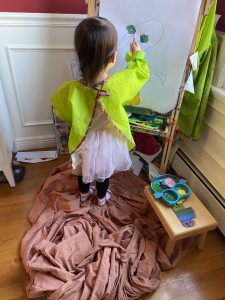
Your child isn’t the only one that needs a smock! Like most things in parenting, a little bit of preemptive care goes a long way. Save yourself multitudes of headaches before you even begin your project by covering your work area with a drop cloth to catch spills, dropped paintbrushes, or that most insidious of whimsical craft supplies: glitter.
Don’t have a drop cloth lying around? Here’s where the resourcefulness comes in! A mentor I once worked with introduced me to the wonderful hack of old bed sheets. Instead of throwing out a worn-out old set, keep them wherever you store your craft supplies and spread them out before a project. Pro tip: Fitted sheets hug the edges of most tables perfectly, draping just enough to cover all surfaces, and buy some insurance for anything your kids may drop onto their laps or the chairs. Flat sheets work great to cover the floor under an easel.
Do you have a particularly goopy project coming up? Save those plastic tablecloths from your kids’ birthday parties! Give them a light wipe-down to remove any stuck-on party treats. Otherwise, roll them up and keep them handy for the next time you’re working with glue, Mod Podge, watercolors, or glitter. They cover the table perfectly and when you’re done, you can roll the outside edges toward the center and get all of the scraps and sticky stuff into the trash without having to get out a single wipe or broom. And the bonus is, now you’ve given this single-use plastic 1 or 2 more uses before it goes in the trash!
One of a Kind Wrapping Paper
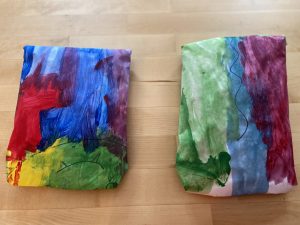
If your kids are anything like mine, they spend a lot of time at the painting easel prolifically producing mountains of masterpieces. And while these are lovely, there are too many to save (unless you’re looking to do some extremely unique and abstract wallpaper).
A sad thing is that once the paper is painted, it is no longer recyclable. As it turns out, most wrapping paper is also not recyclable. You can solve both of these problems by using your children’s paintings as wrapping paper! You’ll be giving a gift in a personalized one-of-a-kind wrapping paper–which in my experience, makes the recipients so excited, they’re often reticent to tear it. And the added benefit is, you’re keeping wrapping paper out of landfills and giving the painted paper one more use before it goes in the trash.
Paint Palettes
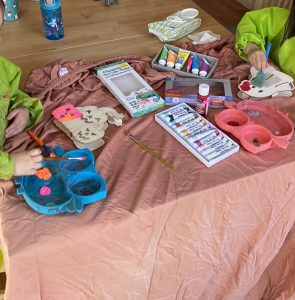
While paint cups are a lower-spill way to go, I find them a pain to clean and find that they limit the number of colors your child can paint with. My kids are much happier when I can let them have a Bob Ross-esque palette of many colors to work with. I’ve found a couple of things around the house that help me with this!
Produce trays from your fruits and veggies make excellent palettes. The ones our cucumbers come on are frequently Styrofoam and cannot be recycled. I keep these and use them 2-3 times each before we throw them out. Their surfaces are easy to clean. In many cases, the paint slips right off with running water. I pat them dry with a towel and then leave them on the easel to dry out until the next time we need them.
Old toddler plates are another excellent palette choice. Once my children outgrew these, I added them to the easel. Toddler plates are great because they’re often compartmentalized, so you can separate colors that your child does not want to risk mixing. The plates are usually plastic or silicone. With just a little water and a squirt of dish soap, the paint runs right off them so that you can use them again and again.
Popsicle Drip Catchers
This last one isn’t an art suggestion, but it is worth sharing. Popsicles are a fun summer treat or a soothing remedy for a sore throat. Popsicles are also notorious for leaving drips wherever your child roams and for giving children remarkably sticky hands. Solve this problem easily by making a drip tray. Save the lid to your big container of yogurt (or anything that comes in a plastic tub). Use a sharp knife to cut a small (1/2 centimeter slash) X in the center of the lid. Slide the popsicle stick through the lid and hand out the popsicles. You’ve found a way to reuse something out of your recycling bin, and you’ve saved yourself a world of stickiness. The good news is, they last forever. I keep mine behind the kids’ cups in the cabinet and just realized that they are going on 4 years old!
The key to successful and not painful art with small children is thinking ahead and (literally) covering all your bases. By using and up-cycling things you have lying around your house, you can buy yourself a fun and stress-free project time with your little ones.