







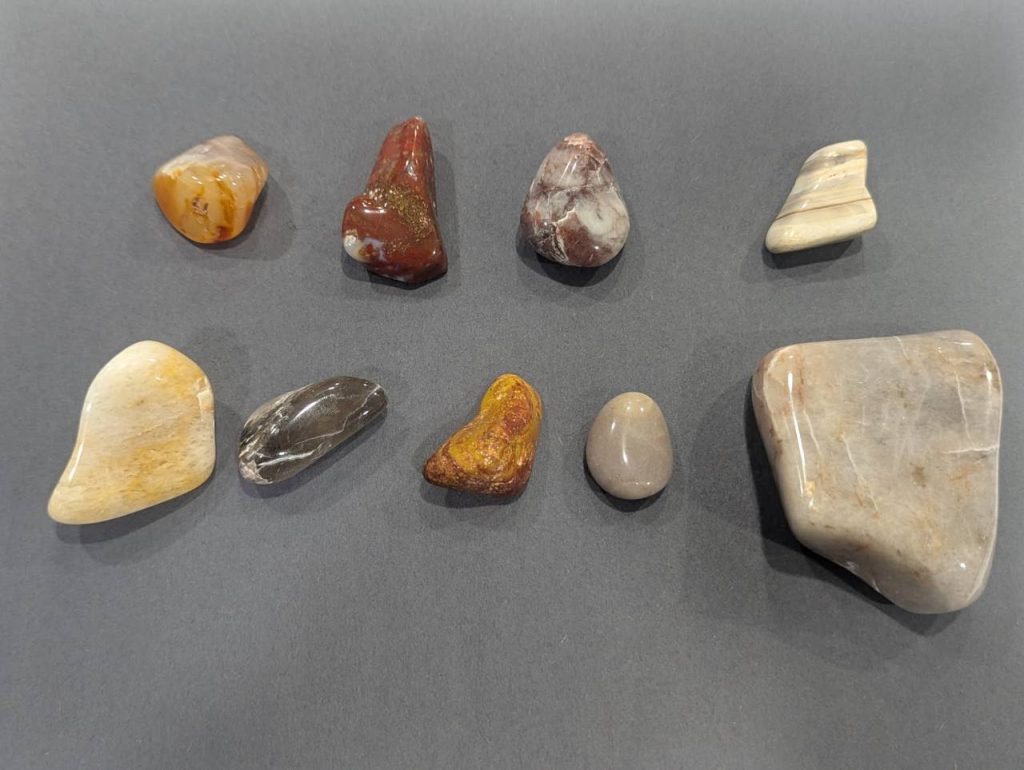
My husband is a very involved dad to our two sons. If there is a spectrum of nerdy to cool interests, my husband’s tend to fall in the nerdy range. He won’t be coaching our sons’ sports teams or teaching them how to play guitar. So what’s a nerdy dad to do? My husband discovered rock tumbling as a great hobby to do with our six-year-old son. If you’re anything like me, you may not have known that this is a thing. The best way I can explain it is the process of transforming a regular rock into one of those shiny stones you can buy in a museum gift shop.
The First Step in Rock Tumbling

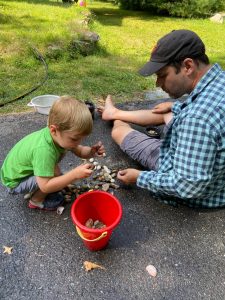
The fun starts with finding interesting rocks, a pastime that many young children seem to gravitate to naturally. Anyone else’s kids come home from preschool with more rocks from the playground than artwork? If so, you’ve already started the hobby!
Some other ways to collect rocks are on hikes or trips to the beach. Before you know it, you and your family will be admiring rocks and spotting “good ones.” My husband’s advice is to choose nonporous, fairly smooth, and homogenous-looking rocks because they have less “pitting” when tumbled. If you know how to identify rocks, most tumbling enthusiasts recommend choosing quartz and jasper in our region. You can also buy rocks to tumble from websites such as The Rock Shed.
The Next Step
Buy a rock tumbler and grit, which is the stuff that tumbles with the rocks to make them smooth. Here are links to two good options for tumblers and the grit:

The tumbling process usually takes about a full month, roughly (pun intended) one week for each of the four stages: shaping, rounding, pre-polish, and polish. There’s no question that some patience is required. While patient is not a word that comes to mind when describing my son, this process has maintained his interest, and his excitement when seeing the rocks’ transformation is contagious. Here is a guide to get started and a video that thoroughly explains the process.
An Educational Perk
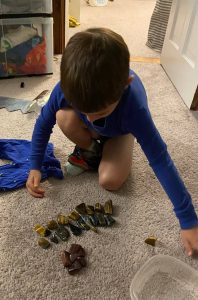
As an educator, I’m always excited to see my sons drawn to activities that are building foundational academic skills. Rock tumbling certainly checks that box. Not only does this hobby promote an understanding of scientific topics such as geology and observation, but it also lends itself to mathematical concepts, such as counting, sorting, and categorizing, and the process builds vocabulary. After tumbling tiger eye rocks, for example, he sorted them by color and counted them to see which collection was bigger. While “rock crumb” may not be a technical term, my son coined this phrase for a small piece of rock that breaks off in the tumbling process. It’s worked its way into our vocabulary now.
Rock tumbling is an interesting and wholesome activity that can be done year-round. Our two-year-old son is getting interested as well. We returned from a trip to the Cape this summer with a large bucket of rocks. The father-son bonding time in the next few months will hopefully yield some museum-quality, Cape Cod stones!