




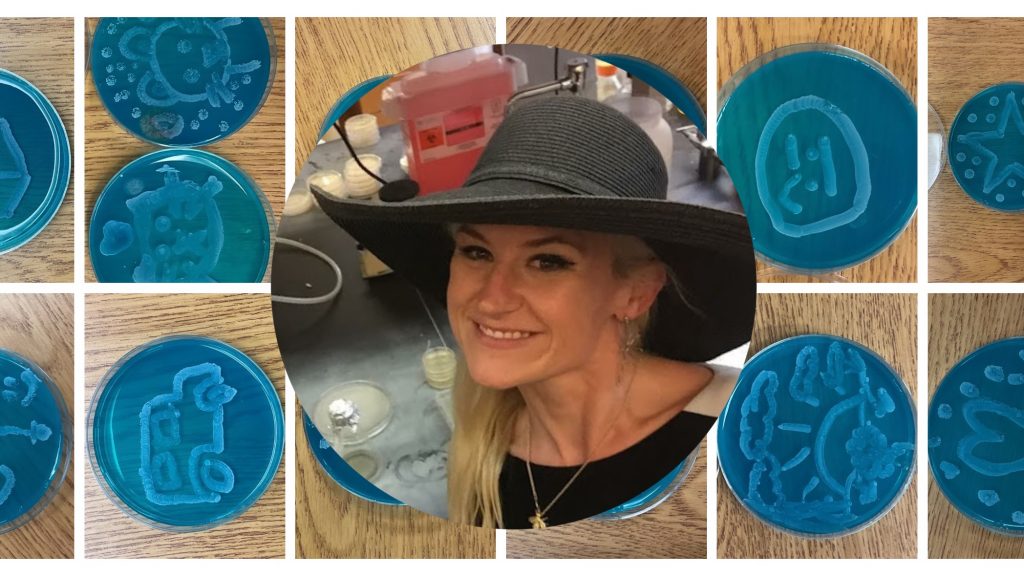
 I am honored to share a special interview with Dr. Anne A. Madden, an award-winning scientist, science communicator, and serial entrepreneur. She believes microbes hold the solution to many human problems and has presented about her work all over the world. She has a new project with her nonprofit, The Microbe Institute, that is the perfect activity to do with kids this summer (or any time of year)!
What participatory science project do you recommend for Massachusetts families to do together?
Our newest project: Kitchen Microbial Art. It’s a participatory science-art activity available to all audiences. Anyone at home or in a classroom can create Microbial art.
Microbial art refers to painting in a Petri dish on agar with living microorganisms. An image emerges over a few days as the cells replicate. This form of science-art dates back over a hundred years and is growing in popularity. Traditionally, microbial art has been relegated to science laboratories for safety because it typically requires specialized skills or equipment.
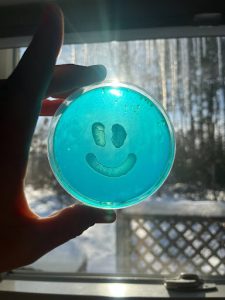
However, our team developed a method that can be done at home using accessible supplies: The ‘paint’ is dehydrated Baker’s yeast mixed with water (or sourdough starter) painted on Petri plates filled with a canvas of suitable nutrients, using a Q-tip as a paintbrush. We have created various activity sheets* to introduce science while painting. Your kids can learn about beneficial microbes in their world, engage with their creativity, and watch over the next few days as the yeast cells replicate and the “invisible” paintings emerge.
* Please see the full preprint protocol for suggested safety notes and suggestions for how to dispose of the art following growth.
Why is this project of value to the scientific community?
This project addresses a major challenge we have in science and society: how people perceive microbes, and their awareness of what microbes make possible. This activity encourages people to think about microbes beyond ‘germs.’ We share images of the artwork on our website, so everyone can see microbes in a new, more favorable light.
We’re also using this project to gather pilot data on how related science-art activities can shift negative perspectives around microbes and foster curiosity. Any feedback you and your child have about this project is helpful to our broader scientific mission of fostering microbial discovery for a better tomorrow!
We also encourage people to try our Lichen Adventure for a zero-cost alternative where kids ultimately help scientists better understand where the world’s lichens are while recording field observations like scientists. For a deeper dive into the science of microbiology, I recommend the free activity book created by one of our fellows.
What got you into microbes?
I grew up on the coast of Maine. I spent my summers exploring tide pools and the woods. I never envisioned myself as a scientist until college, where I had the experience to participate in real research in the Costa Rican jungle. I was serving as a research assistant to scientists studying the toxins in poison dart frogs. I fell in love with the jungle, the life in it, and how many things remain unknown. I missed the jungle when I came back to college in Massachusetts. Everything felt known and mundane until I joined a microbiology research lab and learned about the microbial jungle around us.
I was fascinated to learn that our indoor spaces are host to microbial species we know nothing about. Over 99% of microbial species (those invisible creatures that include fungi, bacteria, protists, and viruses) on this planet are unknown to us. While we tend to fear microbes, most species don’t hurt us; many benefit us.
From that 1% of microbial species we do know, they are the source of some of our most remarkable technologies. Microbes in our soil are the source of many of our life-saving antibiotics and chemotherapeutics; they are critical for growing crops and fermenting foods, and microbes are key players in biotechnology.
Microbes are remarkable. You only need to grow some of them in a petri dish in a lab to see how they can be startlingly gorgeous. Some look fiery-orange, others are exquisite hues of lavender or deep cerulean. Some even look like holographic stickers. When I learned this, I was hooked.
I’m now a “microbe wrangler.” I work with groups across the world to find new microbes to improve our world and engage the public in this wonderful world of the microbial cosmos.
What do you feel is the most vital personality trait of a scientist?
I think all scientists embrace a duality of fierce perseverance and insatiable curiosity. They are not afraid to ask “why” and find out “how” the world works around them. Wonderfully, these are skills that can be developed with practice and nurturing.
What do you believe is the best way to promote curiosity in our children?
I think giving children access to spaces where they can explore nature and contribute to meaningful community projects is an exceptional way of not only promoting curiosity but sparking wonder and encouraging empathy-building efforts; they can transform fear into wonder.
 Dr. Anne A. Madden is the Founder and President of the nonprofit, The Microbe Institute. The Technology Co-Founder and Chief Scientific Officer at the food & beverage technology company Lachancea LLC. She also consults at Imnovate Consulting, where she helps life science organizations innovate their research and science communication.