






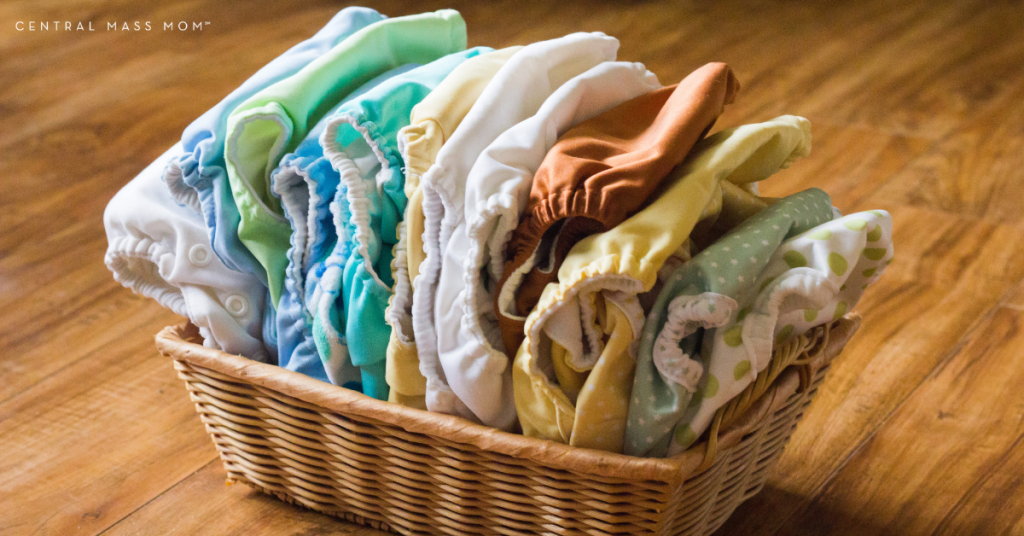
 I’m that mom who will change their baby’s diaper literally anywhere, so when people notice the cloth diapers, we get lots of questions about our experience. Older generations marvel at the advancement in cloth diaper technology, like the stretchy silicone fasteners (called “Snappis“) because they remember the days of fastening diapers with clothespins. Younger parents tend to make two assumptions: that we choose to cloth diaper for the benefit of the environment and that cloth diapering must be a total pain in the butt! And while those assumptions aren’t necessarily untrue, they don’t quite capture the full benefits of cloth diapering.
We started cloth diapering when my first child was born, and at the time, I was primarily motivated by limiting how many diapers we sent to the landfill. But my motivations changed over time as I experienced the many other, more personal, benefits. There are so many styles and methods for cloth diapering that are available these days. Also, there are a ton of YouTube videos out there to break it all down for you. I knew nothing when I first started, but I have figured out a good system through trial and error.
Of course, there is no doubt that disposable diapers are far more convenient for busy parents than cloth diapers. This is why the style of the cloth diaper or the system of washing that you use is far less important than being really clear on why you are doing it. Otherwise, that initial learning curve before finding your groove will likely make you want to give up! And remember, if you choose to cloth diaper, there’s no need to be a zealot about it. You can mix and match cloth diapering at home with single-use diapers on the go or cloth diapering during the day and disposables at night or any other type of hybrid method.
There is no one-size-fits-all way to go about cloth diapering, but here are some unexpected benefits of cloth diapering:
Earlier potty-training
On the top of my list of reasons why I love cloth diapering is how quickly kids potty-train with them. And let me be perfectly clear, my least favorite parenting chore is changing diapers. Ask my husband. Both of my kids are absolute wigglers! My son would also scream bloody murder every time he was put on his back to have a change because he hated being still. So it was quite a happy surprise to us when before he even turned 2 years old, my son would tell us when he needed to poop. We could take him to the toilet without anyone actually “potty-training” him. He was also fully potty-trained with both pee and poop during the day and at night well before he turned 2-and-a-half. It was such a freeing feeling as a parent to have a child totally out of diapers at that age!
It turns out that before the mass production of disposable diapers took hold in the mid-1980s, after advances in adhesive technology and the advent of absorbent gels that soak up the moisture, nearly everyone used cloth diapers, and children were potty-trained on average at least a full year earlier than children are these days. This is still the case in countries where cloth diapering is the norm.
Cloth diapers help children gain the ability to understand and interpret sensations within their body, also known as interception, such as the urge to use the bathroom. Making the connection between the internal sensation of having to go with the external sensation of feeling wet helps speed up their potty training journey. Anyone who has cloth-diapered an infant will tell you that baby knows when their diaper is dirty. Even newborns react to it in a specific way—no wetness indicator is needed! Be forewarned that with cloth diapers you end up doing diaper changes more often throughout the day. The trade-off is that they are out of diapers a lot sooner overall. Plus more frequent diaper changes mean fewer opportunities for a diaper rash to develop.
Gentler on baby’s skin
Cloth diapers are typically made from 100% cotton and are free of chemicals that are absorbed through the skin. Kiddos with sensitive skin may react to the colorants and fragrances. Also, there are numerous other chemicals in disposable diapers that are linked to cancers and infertility in adulthood. Although there is no way to completely protect our children from the chemicals in our modern world, cloth diapering is a great way to limit their exposure at a point in time when they are most vulnerable. There are diaper companies now that are mindful and transparent about the chemicals in their products, but these are niche brands. They are usually much more expensive than the traditional brands available in stores.
Great for your wallet
Another great reason for cloth diapering is that it’s cost-effective. There are a zillion different styles of cloth diapers. Even the fanciest cloth diapers will only cost you a fraction of the cost of buying disposables every week. And you can reuse them for subsequent kids!
If you would prefer not to have to wash your own diapers, there are diaper services, like Kind By Nature which serves Central Mass, that will drop off clean diapers on your doorstep and pick up the dirty diapers each week.
A diaper service typically has a package that you purchase at the beginning. It includes your odor-proof diaper pail and other supplies. Then you make recurring monthly payments for the actual service. This can cost around the equivalent of a month of disposable diapers or sometimes even less. Many diaper services will also provide an in-person or virtual tutorial on cloth diapering basics. You can even put all your cloth diaper supplies and the cloth diaper service on your baby registry!
Let’s face it, the entire nature of parenting is a series of (very worthwhile) inconveniences. So I like to think of cloth diapering as leaning into that inconvenience in order to reap the hidden benefits for my kids and myself! The benefit to the environment is a happy bonus.