



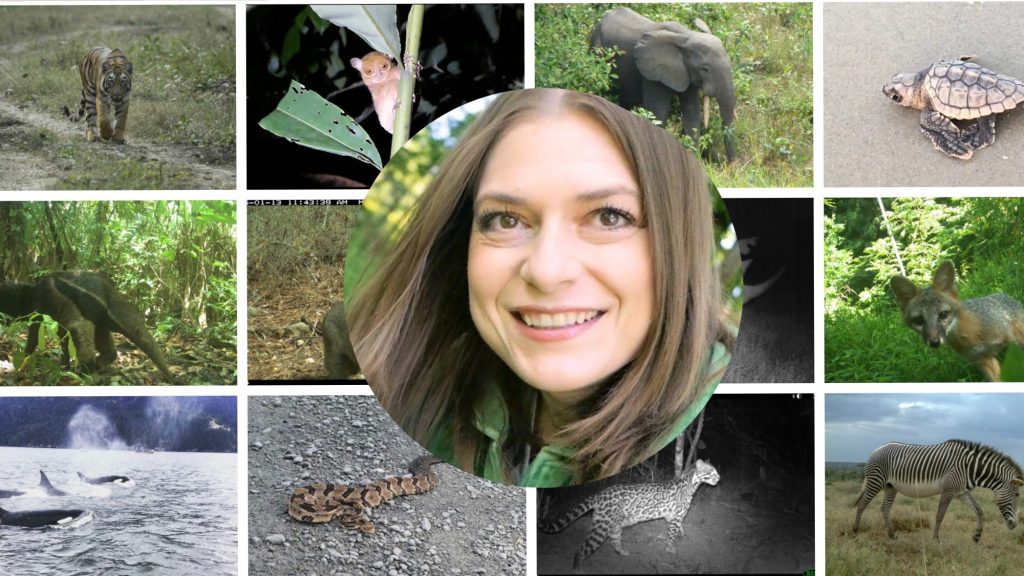
 I first met Dr. Stephanie Manka, or The Fancy Scientist, at the North Carolina Museum of Natural Sciences she was working with teachers to co-create participatory science projects and lesson plans based on her research on mammals using camera traps. She’s helped thousands of students around the world do real science and guides aspiring scientists through their careers as well. I’m grateful we were able to catch up, and she shares her favorite participatory science projects to do in Central Massachusetts!
What participatory science project do you recommend that Massachusetts families do together?
Stephanie: The first one is iNaturalist. This one is just so easy, and I recommend it for several reasons:
- It gets you to start noticing the world. Once you start documenting the nature you find around you and giving it a name, you start to create connections and see it differently. Plants are no longer plants, but they are specific species like prairie trillium or purple coneflower that you then recognize and see over and over again. Once they have a name, you start building a relationship with them.
- It allows you to build your own biodiversity database. It’s so much fun to look back at your observations and see all of the places you have captured nature across the world. It’s so cool to see what projects have used your data.
- It’s SO easy. All you have to do is take a photo and upload it. I love to use it with Seek, also owned by iNaturalist, which allows you to hover over organisms in real time, and the AI tool identifies them (great for plants and slow insects)
The second one is Merlin Bird ID, but to make it participatory science, you need to upload your data to eBird. I love Merlin because:
- I have never been able to identify birds by song. I would read what the song sounded like, but could never place the words in the text with the songs in real life
- It automatically picks up bird song as they sing and IDs the species in real time! This has allowed me to find new species I have never seen before, as well as learn the common bird songs around me. It’s improved my life list so much!
What got you into this?
Stephanie: I just wanted to learn more about the wildlife around me. I always thought biodiversity was in faraway places—like Africa or the Amazon rainforest. And I did my research in Central Africa. I didn’t notice the biodiversity around me as much and thought it was all common and studied, but then once I started to look more closely, I realized that we have amazing species all around us. Just this week, I’ve seen beetles the size of my fingernail and found metallic green sweat bees on flowers—animals that you think would be in distant jungles. I also feel good knowing that I am documenting nature for scientists and future generations to come.
What experience from when you were young piqued your curiosity?
Stephanie: I always loved animals, and my parents fostered that in me – or maybe they loved animals too, and they shared that with me. Whenever we found an animal, it didn’t matter if it was big or small; we observed it. This could be the spiders that were inside our house, potato bugs that we found from flipping over rocks in our front yard, frogs and snakes near ponds, or when we would travel to this state park two hours away, using large floodlights to attach to our car and scanning the park for nighttime animals. I was curious and interested in all of them!
What do you feel is the most vital personality trait of a scientist?
Stephanie: To be curious and ask questions. We ALL start out that way as kids, but as we go through the school system and grow into adults, we are usually subconsciously or directly taught to stop asking questions. In school, I assumed so much was known, and in science class, we memorized facts and concepts and then had to reiterate them for tests. It wasn’t until my Ph.D. that I really learned that science was about asking original questions! Even though I had participated in research in internships prior to that. I was so good at school, that is studying and memorizing for tests, that I lost the ability to ask questions. I was so used to being told what to study or what was important.
What do you believe is the best way to promote curiosity in our children?
Stephanie: Promoting curiosity in kids is core to my mission as an educator! We don’t have to promote curiosity as kids are innately curious, as much as to make sure we maintain it and enhance it, kind of like fanning a fire, but there are things working against us. Namely, there is a lot of competition for their attention from screens, and there may be stigmas already about going outside (e.g,. it’s hot, there are lots of bugs, etc.) This is exactly why I started the Wildlife Biology for Kids Club this year! It’s designed to show parents how to open kids’ eyes (and their own) to the natural world and get them asking questions. Each lesson is based on the following principles to keep them curious:
- Showing kids how to notice, observe, and pay attention to the natural world – so many things are overlooked! It’s so easy to miss out on teeny tiny bugs that, when you take the time to look at them, can look like beautiful alien life forms that you’ve never seen before
- Providing information about a topic that they might now know; something to spark their curiosity and get them interested
- Asking kids questions about what they see and encouraging them to ask their own, if they are struggling, help them form questions
- DON’T answer their questions right away, even if it is an obvious answer. Ask them questions back about what they ask. Try to get them to think of multiple explanations for what they observe. Why do they think that animal is doing that? Or looks that way? Later on, you can look up the known answer (if it is known!), but first get them thinking about the answers to their own questions
- Participate in community/citizen science as much as possible so that they can see that there is still so much to learn (scientists don’t know it all and need your help with the species around us), that they can have an impact, and that they can have agency/a sense of accomplishment as well as more of a connection to their area and the organisms within it.
 You can watch the videos on YouTube, and if parents want to go deeper, they can become a member to download the activity guides and worksheets, as well as connect with other like-minded and me, a real wildlife biologist! You can enroll here. Also, wildlife is not just limited to animals! By modern definition, wildlife covers all living things, so the topics extend to plants and fungi as well.
Dr. Stephanie Manka has been a wildlife biologist for over 20 years. She is a digital content creator teaching people about wildlife, conservation, and science. She empowers and prepares aspiring and entry-level wildlife professionals around the world while providing lifestyle solutions to collectively make a difference, helping wildlife and restoring the planet. You can learn more about Stephanie and her work at her website.