






I want to raise curious children and support their varied interests, so one of my favorite things to do is ask scientists about what made them the person they are today. What made them so curious? This is the first part of a “Staying Curious with…” series, wherein I ask my favorite scientists questions about how my fellow Massachusetts families can participate in scientific research and if they have any advice for how to raise curious children. My first interview is with the renowned scientist, professor, and proud father, Dr. Madhusudan Katti.
Which participatory science project do you recommend Massachusetts families do together?
Most of my research and interest centers around bird monitoring – whether it’s using eBird, Merlin, or iNaturalist. These allow you to collect data and make it easy to identify bird species.
You can identify and document birds easily, by image or by sound. These apps are also good ways to learn about birds. If school kids wanted to document birds at their school or around their homes, for example, they can learn to identify birds using the free Audubon Guide to North American Birds and the Merlin app from the Cornell Lab of Ornithology (which is also free) and allows you to identify birds by sound. You can confirm the identifications, and these are skills the kids can learn to identify birds. Families can use eBird to see what other birds have been reported in their area, or in their city, on a map.
Why is this project of value to you and the scientific community?
People can document all kinds of wildlife around them. These apps allow you to learn about other beings around you – what species we share our home or habitat. It also allows you to keep track of any changes in your environment; you can compare data year after year. With your eBird data, you can see if there are any environmental changes. Are birds arriving at different times in the Spring? People have been able to use eBird data to see the effect of storms on migration data because you can see if the movements of animals have changed. This is useful for scientists to do deeper and more long-term data; it’s about documenting what’s going on around you.
What got you into monitoring bird species and participatory science?
My work is looking at how socioeconomic and racial disparities and how that affects access to nature. You can look at datasets collected by people over time and see if there are systematic differences in the kinds of nature that people are exposed to. Are there reasons for these differences? It might be because of different kinds of investments in parks or landscaping. Wealth might affect how people manage their environment, it might be because of historical reasons; some neighborhoods were segregated in the past. More racially segregated neighborhoods using redlining policies have disparities; historically black neighborhoods have less trees, for example, and therefore less tree cover. This has health effects, and urban heat is increased in these areas. Or it could have something to do with what someone is doing now – do they have lawns or more wildflowers? How often they mow their lawns can impact who is there. A study at the University of Massachusetts, Amherst, showed that mowing a lawn once every three weeks versus once a week significantly increases the number of pollinators that can be found in a yard. This can empower communities to make changes in their own environments.
What experience from when you were young piqued your curiosity?
Boredom, perhaps? Being bored and being in nature is good for kids, because there is always stuff around.
I had innate curiosity when I was a child; I also didn’t have any television when I was a child; there were no apps. As a child, we had a small yard with a few trees, so after school, I might have some homework, but I would spend my time in my yard, mostly sitting up in a tree or playing pretend with my friends in my backyard forest. One of my favorite pastimes in the evening was watching the geckos running around the house. They would hide behind fixtures during the day, and at night, they would come out and catch bugs around the lights. I learned how they could drop their tails as a defense mechanism long before I learned about it in biology class. I didn’t know what the scientific names of these species were when I was younger, but we had our local names for things. I loved watching ants in the monsoons – they would move their colonies in the rain and flooding.
What do you feel is the most vital personality trait of a scientist?
Curiosity, obviously, everyone says this. But perhaps more important is humility. Being willing to accept that you are wrong and can change your mind. Be willing to say, “I don’t know, but I’ll find out,” or “I was wrong.” Acknowledging you’re wrong and then looking to find the right answer, this is something many people struggle with.
What do you believe is the best way to promote curiosity in our children?
Let them be bored. Some things I wish I had when I was younger were apps like iNaturalist, eBird, and Merlin, so I could also find out what things were!
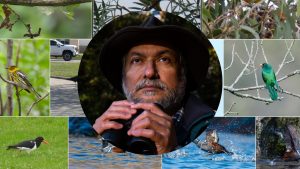
Dr. Madhusudan Katti is the Director of Science, Technology, and Society and Associate Professor for Public Science at North Carolina State University. He is the Editor-in-Chief of The Bulletin of the Ecological Society of America.