







 Nobody Told Us It Would Take This Long to Feel Like Ourselves Again
New research puts real numbers on the postpartum recovery timeline — and validates what so many moms already know but rarely say out loud.
If you’re a mom who is still waiting to feel fully like yourself again after having a baby — whether that baby is six months old or six years old — this research is for you.
A new survey of 2,000 women who have given birth, commissioned by Intimina and conducted by Talker Research, looked honestly at how pregnancy and childbirth affect confidence, identity, and intimacy over time. The findings are not surprising to anyone who has lived them. But there is something powerful about seeing the experience reflected back in data — proof that what you’ve been feeling privately is actually widely, quietly, universally shared.
The Timeline Nobody Prepares You For
The average woman takes five months to emotionally recover from pregnancy. Six months to physically bounce back. And 77% of women surveyed said their body has simply never returned to how it was before having a child.
Of those women, 63% aren’t sure it ever will. That number rises to 67% among moms who gave birth three or more years ago — women who are well past the newborn fog and still making peace with a body that permanently changed.
We talk a lot about the first few weeks postpartum. We talk less about the months and years that follow, when the casseroles have stopped coming and everyone assumes you’ve “bounced back” — but you’re still quietly figuring out who you are now.
While more women said the physical recovery was harder (42%), more than a third found the mental and emotional recovery more difficult (35%). Nearly a quarter said both were equally hard. There is no version of this that is easy, and the research doesn’t pretend otherwise.
The Pressure to Be “Ready”
One of the most quietly damaging things about postpartum recovery is how much of it happens against a backdrop of external expectations. One in six women surveyed felt pressured to be physically intimate again by the standard six-week postpartum checkup deadline.
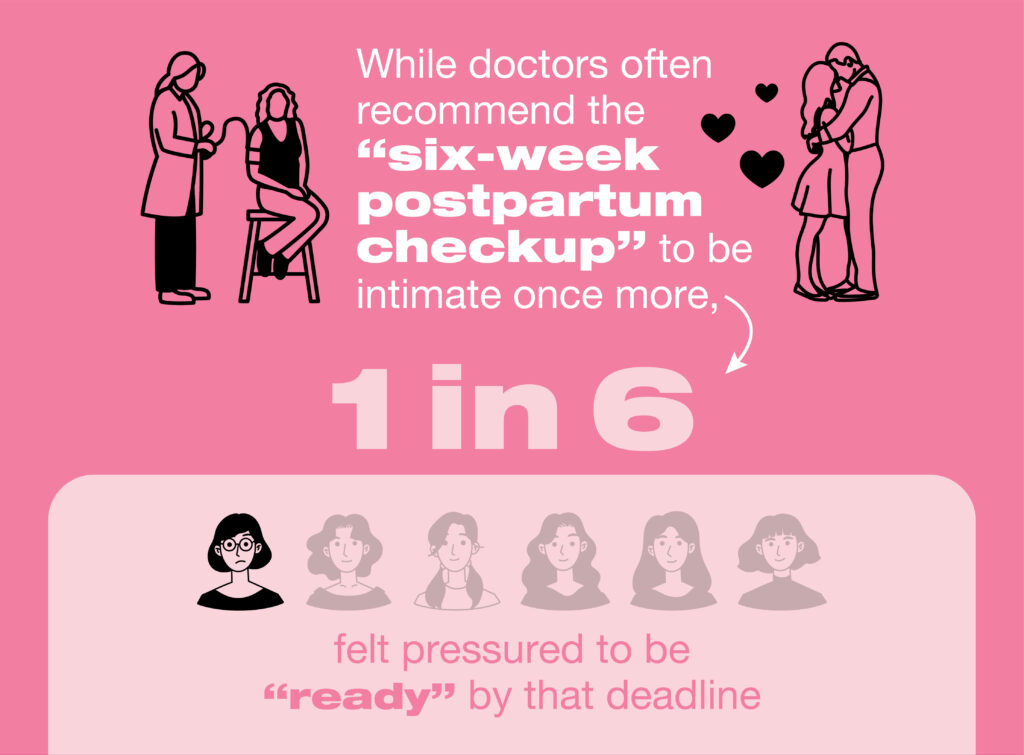
Six weeks. After everything a body has just been through.
“There is still an intense and often silent pressure on women to quickly ‘bounce back,’ both emotionally and physically,” said Dunja Kokotovic, global brand manager for Intimina. “We need to shift the public narrative toward acceptance and self-care instead of chasing unattainable standards.”
The most common negative experiences women reported around postpartum intimacy were fatigue (26%), feeling pressured to be in the mood (21%), guilt about not wanting to be intimate (19%), dryness (18%), and emotional disconnect (17%). What’s striking about that list is how many of those experiences are about pressure and expectation rather than physical recovery alone.
The Loneliness of Going Through It Quietly
Perhaps the hardest finding in this research is how many women navigated these changes alone. Nearly half of those who experienced body changes struggled to talk to their partner about them (46%). More than half dealt with shifts in confidence (53%) and their sense of self (57%) without really talking to anyone about it.
Sixty percent found it difficult to discuss changes in emotional connection with their partner, and 52% struggled to bring up changes in libido.
This isn’t a failure of communication. It’s the predictable result of a culture that celebrates the baby, hands mom a “you’ve got this” card, and quietly moves on — leaving women to process profound physical and emotional changes largely in private.
At the same time, 39% of women who are still with their partner said they feel more connected to them after having a child than ever before. Parenthood can deepen a relationship in real and lasting ways. Both things are true simultaneously, and it’s worth holding both.
What Women Actually Want Now
One of the more meaningful threads in this research is how postpartum experience has reshaped what women want from intimacy — and from their relationships more broadly.
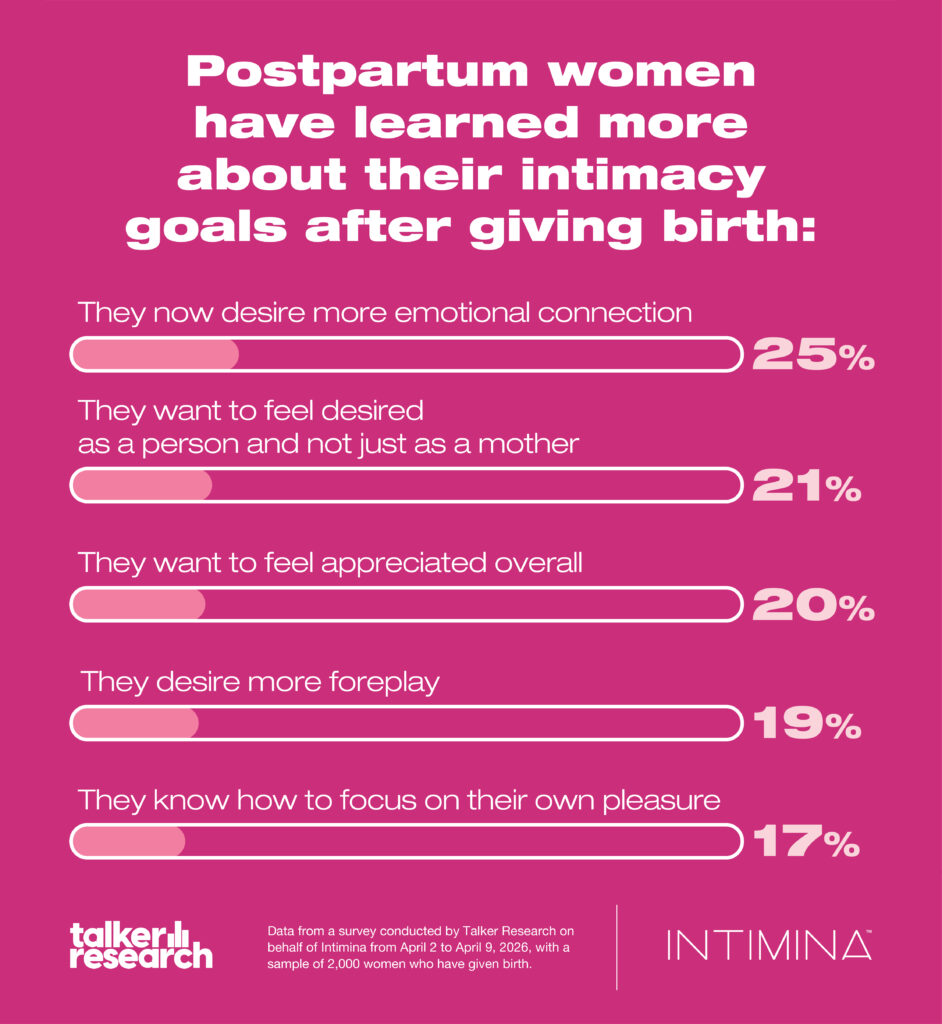
Women said they now prioritize more emotional connection (25%), wanting to feel desired as a person and not just as a mother (21%), and feeling genuinely appreciated (20%). Others said they’ve become more focused on their own experience — more foreplay (19%) and more attention to their own pleasure (17%).
There’s something important in that shift. Many women emerge from early motherhood with a clearer, more honest sense of what they actually need — from their partners, from themselves, from their lives. The research suggests that while the postpartum period is genuinely hard, it isn’t only hard. More women reported improvements in confidence, mental health, and feeling connected to themselves than reported the opposite.
You’re Not Behind. You’re Just Healing.
The six-week checkup is not a finish line. Five months is an average, not a deadline. And 77% of mothers having bodies that are permanently changed by pregnancy is not a statistic about failure — it’s a statistic about transformation.
“It’s important to know that it doesn’t last forever,” Kokotovic said. “Kegel exercises are a perfect solution to pregnancy recovery and taking control of pelvic health — strengthening the pelvic floor is necessary for healing, and it can be especially helpful in building back the confidence needed to reconnect with yourself and your partner.”
If you are in the middle of this — somewhere between who you were before and whoever you’re becoming — the data says you have a lot of company. Women all over Central Mass, and all over the country, are quietly doing the same work you are.
Take the time you need. There’s no timeline you’re failing to meet.
Survey methodology: Talker Research surveyed 2,000 women who have given birth on behalf of Intimina, conducted online April 2–9, 2026.